
Islington will charge for care alarms and fall sensors, free until now for 2,650 users: £4.87 or £9.69 a week, means-tested. Approved 22 October; call-in to 27 Oct.
Updated 23 October: the Executive approved the charges on Thursday 22 October, with the tiered model, a 28-day free trial and no installation fee, according to the printed decisions. Councillors can call the decision in until 27 October; if nobody does, it takes effect on 28 October, the decision record says.
Islington residents who use a council care alarm, fall sensor or GPS tracker could soon pay for it. The service has been free for almost everyone who uses it.
The council’s Executive will be asked on Thursday 22 October to approve weekly charges of:
- £4.87 a week for a “Monitoring Only” service
- £9.69 a week for “Monitoring and Response”, where someone can be sent out
Charges would be means-tested. Nobody would pay until they had a financial assessment, and the first 28 days of the service would stay free. The figures are in the report to the meeting, published this week.
Over a full year, that comes to about £253 for the lower tier and £504 for the higher one, on our calculation from the weekly rates.
Who uses the service
About 2,650 Islington residents use what the council calls Assistive Technology. The report lists the kit it covers:
- alarms
- fall sensors
- medication dispensers
- GPS trackers
The council says it helps people stay independent at home and can delay a move into long-term care. Only about ten users pay now, under older arrangements.
How many would pay
The council does not yet know. Its planning figure is that about two in five current users would still get the service free once their means are assessed. The real number will only be clear when the assessments are done.
The assessment would follow the council’s existing adult social care charging policy. It looks at:
- income and savings
- rent or mortgage, after any Housing Benefit
- council tax, after any Council Tax Reduction
- extra costs caused by disability
People who cannot afford to pay would pay less, or nothing. The council would also offer a benefits check through its income maximisation team, IMAX. It estimates about 350 users could end up better off, but says this is a model, not a promise.
What residents said
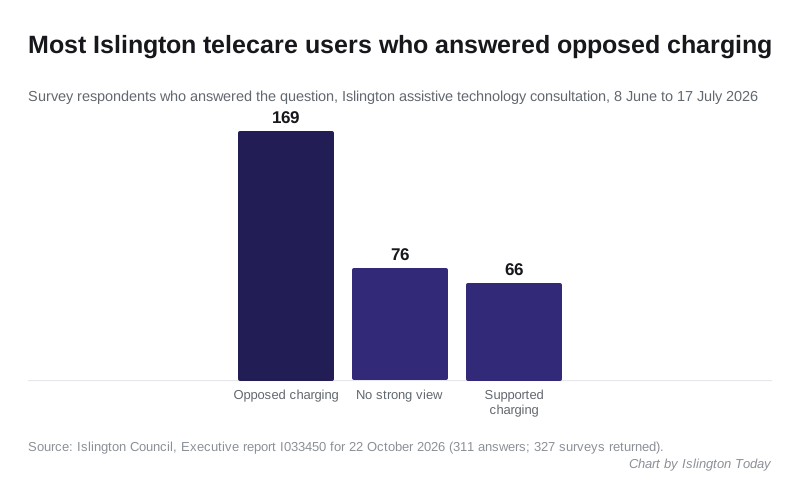
The council consulted from 8 June to 17 July. All 2,650 users were sent a paper survey with a prepaid envelope. It received 327 surveys, 101 phone enquiries, 11 emails and one letter from an organisation. Two drop-in sessions drew five people between them.
Most of those who answered opposed charging.
The respondents were mostly older, disabled people. Three in four were 65 or over, and their average age was 77.2. Nine in ten had a long-term condition.
The most common concerns, by number of comments, were:
- that they or others could not afford it (51)
- that it was an unfair burden on disabled, older or low-income people (46)
- that charges could put people off using the service (26)
- wider cost-of-living pressures (26)
Views split by income. Among respondents with household income below £40,000, 113 of 206 opposed charging. Among those on £40,000 or more, 13 of 22 supported it.
What changed after the consultation
The council consulted on four options. It is recommending the two-tier charge, which had the most support of the charging models. The report is clear that this “should not be interpreted as majority support for charging overall”.
It has dropped a proposed £45 installation fee for new users.
It also rejects two ideas residents put forward:
- exempting groups such as older people, disabled people or people on certain benefits
- a separate power to waive the charge case by case
The report says the means test already protects people who cannot pay, and that group exemptions would not reflect what someone can actually afford.
Why the council is doing it
Charging was agreed in principle in the 2023/24 budget. It was delayed so the council could consult first. The report says that if Islington does not charge, the same saving would have to be found elsewhere in adult social care.
The service costs £2.354m a year. The money that would come in is modest:
- gross income of £0.367m to £0.524m a year, depending on how many people cancel
- up to £0.25m a year in extra staff to run the assessments
- leaving a net £116,549 to £273,642 a year
The report calls these figures “illustrative” and says they are not a guaranteed saving. In 2023 the council had expected about £0.375m a year. The report says the service would stay heavily subsidised even for people who pay.
The risk the report names
The council’s own report says the main risk is that some people cancel an alarm they need because of the cost. Its scenarios assume up to 30% of those asked to pay might cancel.
It promises that no one will lose the service without a conversation and a review of their needs and risks. Safeguarding, mental capacity and carers’ circumstances would be considered. The council says it will track cancellations, complaints, safeguarding concerns and any rise in falls call-outs or hospital discharge demand.
What it means for you
If you or a relative uses a council alarm or sensor, nothing changes yet. The Executive agreed the charges on 22 October, and the timetable in the report is:
- letters to residents about the change: October 2026
- letters about charging and financial assessments: November 2026 to February 2027
- no charge until your assessment is complete
If you are worried you cannot pay, the assessment is the point to say so. Ask about a benefits check through IMAX at the same time.
If you are thinking of asking for the service, the first 28 days will be free, so you could try it before any charge applies. Prices will be reviewed every year.
The Executive met on Thursday 22 October. The agenda and papers are public, including the full equalities assessment.
Sources
- Executive report: The Introduction of Fairer Charging for Assistive Technology, I033450, Islington Council
- Equalities impact assessment, Assistive Technology, Islington Council
- Printed decisions of the Executive, 22 October 2026, Islington Council
- Executive agenda, 22 October 2026, Islington Council
Have your say