
Islington must build 775 homes a year and hit 83% of its target, which triggers a buffer. The Local Plan explained, plus the two schemes reshaping Holloway and City Road.
Islington is the second-smallest borough in London and one of the most densely built, so almost nothing happens here without a planning decision. The borough has an up-to-date Local Plan, which puts it in a better position than most of its neighbours, and a housing record that has fallen short of its own target for the past three measured years.
This page sets out where the plan stands, what the numbers say, and the two schemes that will change the most.
The Local Plan, and why it is not being rewritten
Islington’s Local Plan was adopted on 28 September 2023. It is made up of three documents plus the Policies Map:
- the Strategic and Development Management Policies, which is the main policy document
- the Site Allocations, which identifies specific development sites
- the Bunhill and Clerkenwell Area Action Plan, covering the borough’s southern, most commercial corner
Together they replaced the four documents that made up the old plan: the Core Strategy, Development Management Policies, the previous Site Allocations and the Finsbury Local Plan. The council has also adopted the North London Waste Plan, a joint document with Barnet, Camden, Enfield, Hackney, Haringey and Waltham Forest, agreed in March 2022.
The council’s Local Development Scheme, published in March 2025, is the formal three-year work programme for planning documents. It contains no full review of the Local Plan. The only Local Plan work scheduled is a narrow one: an early focused review of the Gypsy and Traveller policy, which started in March 2024 and runs to a hearing in spring or summer 2027 and adoption in autumn or winter 2027 (Islington Council Local Development Scheme, March 2025).
What it means for you. A recently adopted plan is the strongest hand a council can hold at appeal. If you are objecting to something, the policies in the September 2023 documents are the ones that will decide it, and they will not change in the near future. Several of the supplementary documents beneath them are being updated instead: a new Climate Action supplementary planning document, a rewritten section 106 document, an Inclusive Islington document and a new Statement of Community Involvement replacing the 2017 one.
The housing target, and the gap
Policy H2 of the Local Plan sets an annual housing target of 775 new homes, which builds to a minimum of 13,175 homes over the plan period.
The government’s Housing Delivery Test measures what was actually built against what was required. The 2023 measurement, published in December 2024, is the most recent, and it covers 2020/21 to 2022/23:
Over the three years, Islington delivered 1,719 homes against a requirement of 2,066, a Housing Delivery Test result of 83%. The consequence recorded against the borough is a buffer, meaning it must add 20% to its five-year housing land supply (Housing Delivery Test: 2023 measurement, MHCLG).
The shape of that record matters more than the headline. Islington beat a reduced pandemic-year target in 2020/21, then delivered 449 and 441 homes in the two years after it, against 775 each time. In a borough with almost no undeveloped land, delivery depends on a small number of large schemes completing, which is exactly why the two below carry so much weight.
Scheme one: Holloway Park, and the 116 extra homes
The largest housing site in the borough is the former HMP Holloway on Parkhurst Road, being redeveloped by Peabody as Holloway Park. Islington Council granted the masterplan permission in April 2022 for:
- 985 homes, 60% of them affordable, including 60 extra care homes for social rent
- a dedicated Women’s Building, tied to the site’s history as a women’s prison
- a new 1.4-acre public park, opening the site and its mature trees to the public for the first time
- a new pedestrian route to Trecastle Way towards Tufnell Park
- around 1,800 sqm of commercial space, an on-site skills hub and 51 construction apprenticeships
Phase 1 is under construction and is targeting completion in 2027. It contains 429 homes: 215 for social rent, including the 60 extra care homes, 18 shared ownership and 196 private sale, plus the Women’s Building, the park and the new pedestrian route.
Phases 2 and 3 are being redrawn. Peabody says two things forced it: the new building regulation requiring second staircases in buildings over 18 metres, which eats internal floor space, and rising construction costs. Its answer is to build more homes on the same site. The December 2025 proposals raise the total from 985 to 1,101 homes, with social rent up from 415 to 468 and private sale up from 392 to 458. The proportion that is affordable slips from 60% to 58%, though the absolute number of affordable homes rises from 593 to 643. Some of the Phase 2 and 3 buildings would be 17 to 19 storeys, which is the part neighbours have objected to hardest.
Peabody has been consulting since December 2024 and said in January 2026 that it would bring the changes forward as a section 73 amendment rather than a fresh application, with a 30-day statutory consultation and a decision that can be taken at planning committee. Phase 1 is unaffected either way (Holloway Park FAQs, January 2026 update).
Scheme two: 99 City Road, 35 storeys and no homes
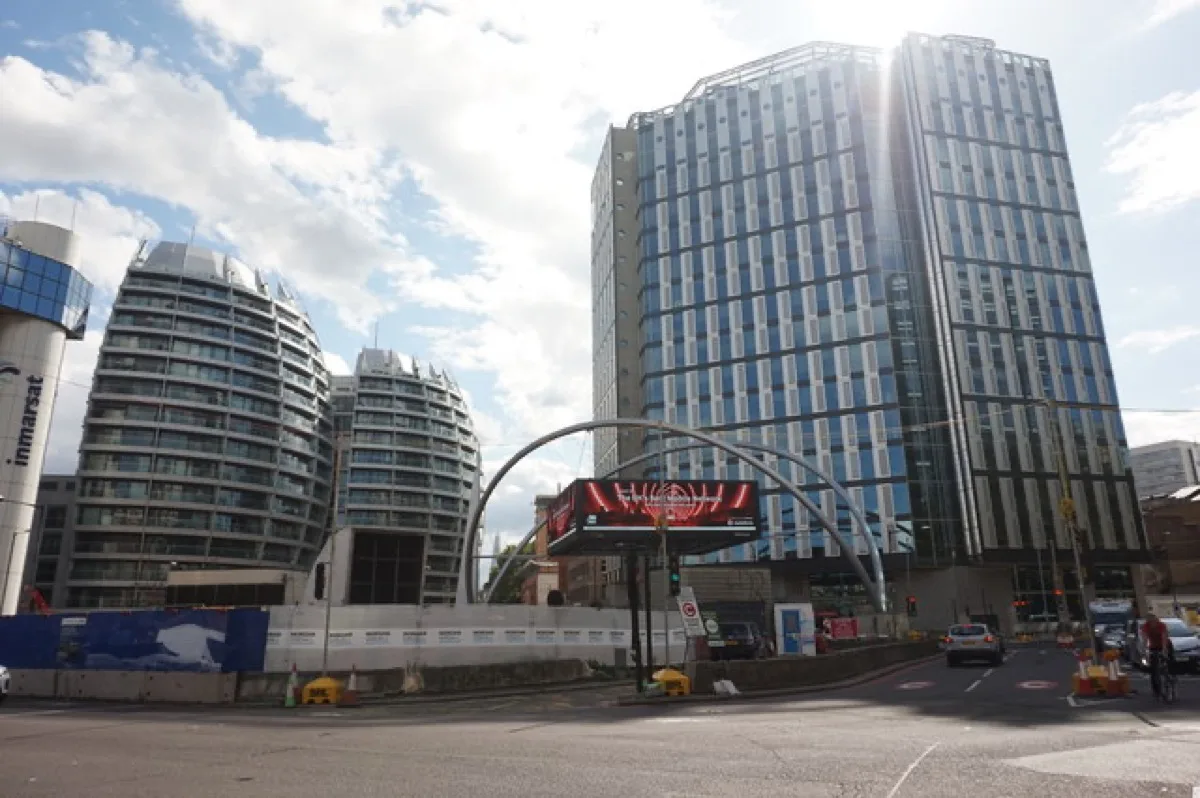
At the Old Street end of the borough, the nine-storey Inmarsat House at 99 City Road, EC1Y 1AX is being replaced by a tower designed by Kohn Pedersen Fox for New Zone Developments. Planning permission was issued on 13 June 2024 for a building up to 35 storeys and 169.26 metres above sea level, which is 151.66 metres above the ground and the tallest thing permitted anywhere in Islington.
It is also a departure from the council’s own development plan. The Bunhill and Clerkenwell Area Action Plan allocates the site, as BC9, for a district landmark building of up to 26 commercial storeys and 106 metres. The consented scheme is nine storeys and more than 45 metres beyond that.
On 7 July 2026 the full Planning Committee considered a section 73 application, reference P2026/0923/S73, to vary the approved drawings, cycle parking and public realm conditions. It would:
| Measure | Consented | Proposed |
|---|---|---|
| Height above sea level | 169.26 m | 170.47 m |
| Office floorspace | 58,925 sqm | 61,532 sqm |
| Total floorspace | 66,521 sqm | 69,297 sqm |
| Affordable workspace | 4,320 sqm | 5,003 sqm |
| Homes | None | None |
Officers recommended that the committee resolve to grant permission, subject to conditions, a deed of variation to the section 106 agreement and any direction from the Mayor of London. Draft minutes for the 7 July meeting had not been published when this page was written, so the committee’s decision is not yet on the record (committee report, 7 July 2026).
The wider point is the one the two schemes make together. Islington is 83% of the way to its housing target, and the biggest building it has ever permitted contains no homes at all. The trade the council secured instead is 5,003 sqm of affordable workspace, up from 4,320 sqm, which the report puts at 12.5% of the net additional floorspace.
How to find and comment on an application
Islington does not use the Idox public access system most councils run. Its planning register is a Citizen Portal at planning.agileapplications.co.uk/islington, which is a single-page application, so it will not show up properly in a search engine and you have to search inside it.
Applications going to committee are a different matter, and easier. Agendas, officer reports and minutes for the Planning Committee and Planning Sub Committees A and B are published in full at islington.moderngov.co.uk, usually about a week before each meeting, and the officer report contains everything: the site history, the objections received and the recommendation. Meetings are held at the Town Hall on Upper Street and webcast.
Three neighbourhood areas have been designated in the borough: Crouch Hill and Hornsey Rise (November 2015), Mount Pleasant, whose forum was re-designated in September 2023 for five years, and Finsbury Park and Stroud Green (September 2018), whose forum has since lapsed.
Frequently asked questions
How many homes does Islington have to build each year?
775, under Policy H2 of the Local Plan adopted in September 2023. Over the plan period that adds up to a minimum of 13,175 homes.
Is Islington meeting its housing target?
No. The most recent Housing Delivery Test measurement put Islington at 83%, with 1,719 homes delivered against a requirement of 2,066 across 2020/21 to 2022/23. That result triggers a 20% buffer on the borough’s housing land supply.
When was Islington’s Local Plan adopted?
28 September 2023. It comprises the Strategic and Development Management Policies, the Site Allocations, the Bunhill and Clerkenwell Area Action Plan and the Policies Map.
Is Islington reviewing its Local Plan?
Not as a whole. The March 2025 Local Development Scheme schedules only a focused review of the Gypsy and Traveller policy, with adoption expected in autumn or winter 2027.
What is being built on the old Holloway Prison site?
Holloway Park, by Peabody: 985 homes with 60% affordable under the 2022 permission, plus a Women’s Building and a 1.4-acre public park. Phase 1, of 429 homes, is under construction and targeting completion in 2027. Revised proposals for Phases 2 and 3 would take the site to 1,101 homes.
What is the tallest building approved in Islington?
99 City Road, at 35 storeys and 169.26 metres above sea level, permitted in June 2024. It is an office building with no homes, and it exceeds the 26-storey limit the council’s own area action plan set for the site.
Where do I look up an Islington planning application?
On the council’s Citizen Portal at planning.agileapplications.co.uk/islington. For anything going to committee, the full officer report is published at islington.moderngov.co.uk.
Related
- Islington house prices: what the borough’s homes actually sell for.
- Islington roads and roadworks: the transport rules that shape what gets built.
- Islington Tube and train times: the connections these schemes are betting on.
Sources
- Islington Council Local Development Scheme, March 2025 for the adoption date, the plan documents, the supplementary document programme, the Gypsy and Traveller review timetable and the neighbourhood areas.
- Islington Local Plan for the plan documents and Policy H2’s 775-homes-a-year target.
- Housing Delivery Test: 2023 measurement (MHCLG, published December 2024) for the requirement, delivery and 83% result.
- Planning Committee report on 99 City Road, 7 July 2026 for the heights, floorspace, affordable workspace and the site allocation BC9 conflict.
- Holloway Park FAQs, January 2026 update (Peabody) for the phasing, tenure tables and the section 73 proposals.
- Islington committee papers for agendas, reports and minutes.
Planning positions change with every committee. Check the council’s own register and committee papers before relying on anything here.
Have your say