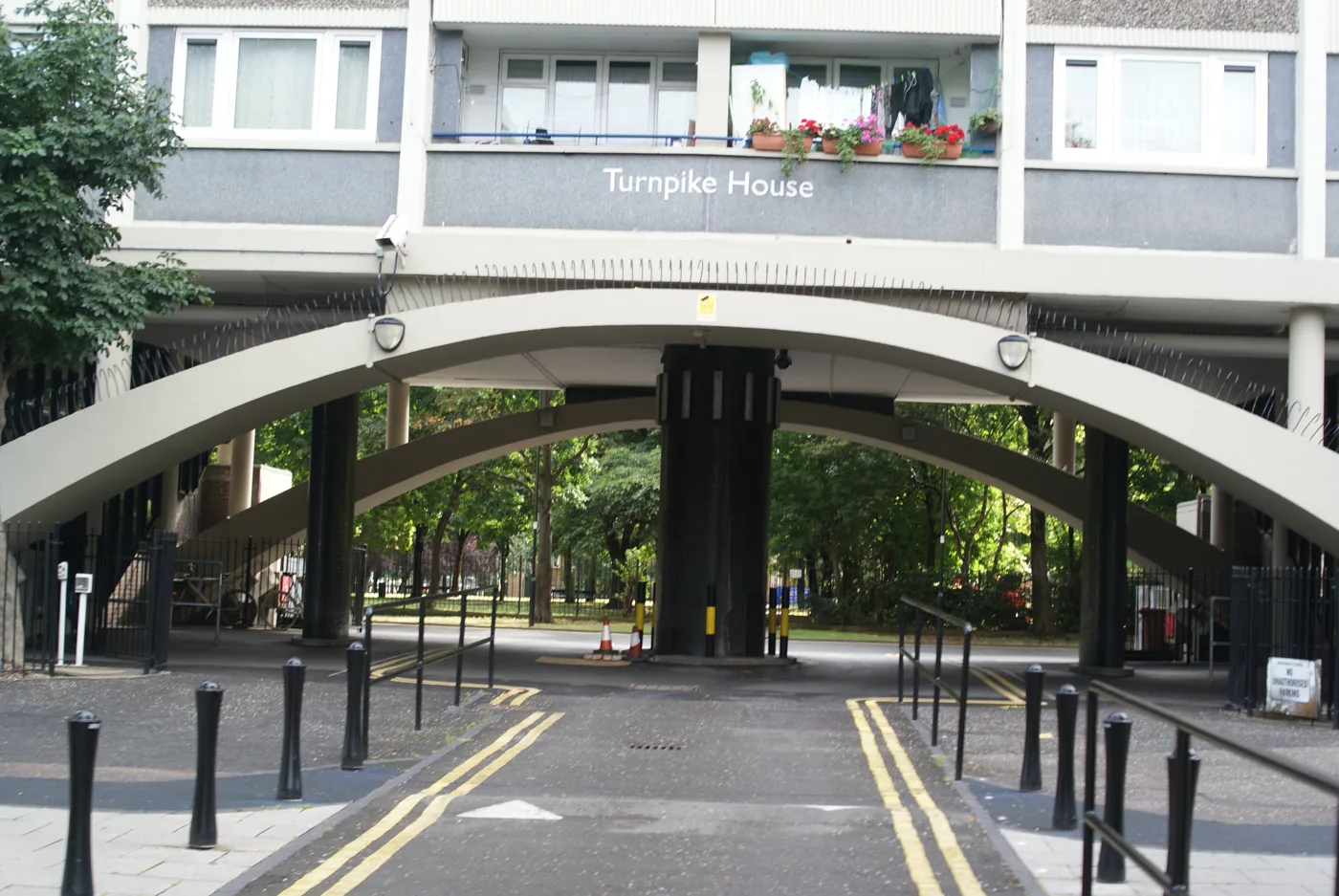

Turnpike House's boilers broke down over 1,000 times in eight years. Islington has approved a £2.5m heating and hot water replacement, due on site from 2027.
Islington Council has approved a plan to replace the heating and hot water system at Turnpike House, the 19-storey council tower on Goswell Road. The old boilers have broken down more than 1,000 times in the past eight years.
The council’s own report says the system is “no longer fit for purpose”. It also records a complete system failure in January 2024 (procurement strategy report, I033271).
The Corporate Director of Community Wealth Building signed off the procurement strategy on 7 October. The work is estimated at £2.5 million before VAT, subject to tender (decision record).
Why the work is needed
The tower has 154 homes and was built in the 1960s. It is part of the King Square estate (equalities impact assessment).
Heat currently comes from the council’s Bunhill Heat Network. The report says that arrangement “lacks sufficient resilience without adequate on-site back-up”. In other words, if the network goes down, the tower has nothing reliable to fall back on.
Hot water is still heated by an electric water heater in each flat.
What the council plans to do
The report lists the main works:
- remove the decommissioned boilers
- re-plumb the plant room so a newer boiler, which already serves King Square, can act as back-up
- install a new high-efficiency gas condensing boiler for resilience and hot water
- fit a heat interface unit in every flat, replacing the electric water heaters
- add new pumps, filters, ventilation and a building management system
Bunhill stays the main heat source. The report says the gas boiler is meant to run only during outages, maintenance or very cold spells, so carbon emissions may rise slightly while it is in use.
The heat interface units give each home its own thermostat and its own meter. The council expects better water pressure and fewer breakdowns. The equalities assessment estimates annual savings of £51,397.80 from lower electricity use.
When it will happen
Nothing starts on site soon. The council will run a mini-competition among contractors on Lot 6 of the Fusion21 heating and renewables framework. Eleven of the 17 eligible firms expressed interest when sounded out in June.
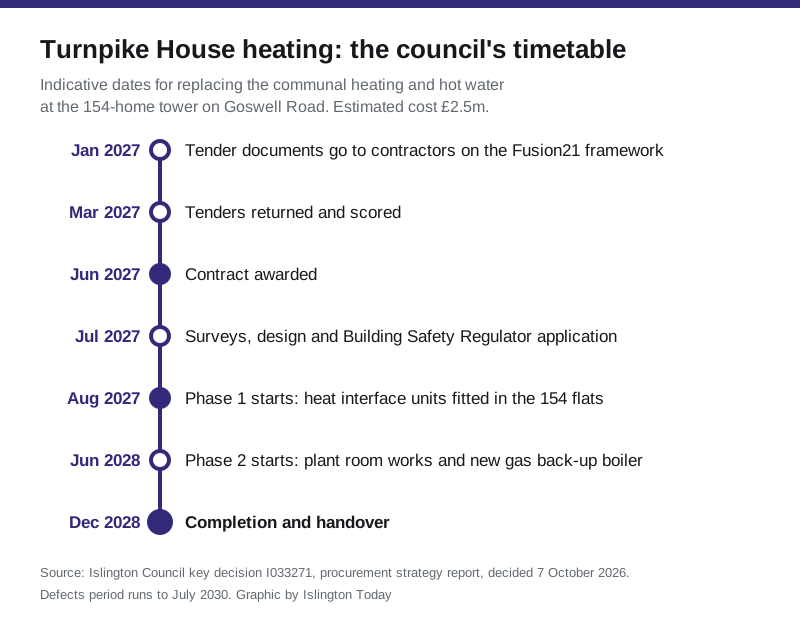
The indicative timetable in the report is:
| Stage | Date |
|---|---|
| Tender documents issued | January 2027 |
| Tenders returned and scored | March 2027 |
| Contract awarded | June 2027 |
| Surveys, design, Building Safety Regulator application | July 2027 |
| Phase 1 on site (work inside the flats) | August 2027 |
| Phase 2 on site (plant room and gas boiler) | June 2028 |
| Completion and handover | December 2028 |
A 12-month defects period follows, ending in July 2030. The council can also extend the contract by a year. The finance section of the same report gives an earlier start date of March 2027; the timetable above is the more detailed of the two.
Turnpike House counts as a higher-risk building. That means the gas boiler and other work inside the flats need approval from the Building Safety Regulator, and the report flags that approval as a high risk of delay.
Who pays
The government’s Heat Network Efficiency Scheme has awarded £0.501 million. The remaining £1.992 million comes from the council’s housing capital budget, from a £5.476 million pot set aside for communal heating in 2024/25.
According to the equalities assessment, 23 of the 154 homes are leasehold. Leaseholders can be recharged for major works. The report rates the risk of leaseholders challenging those bills at the First-tier Tribunal as high.
It also names “Florrie’s Law”. That is a 2014 government direction which, where it applies, caps what London councils can charge a leaseholder at £15,000 over five years for works partly paid for by central government. The council says it will explain to leaseholders how the cap and the grant affect their bills. A formal Section 20 notice of intention and estimate will follow now that the strategy is approved.
What it means for you
If you live in Turnpike House:
- Expect letters about surveys. The council says it will send three letters for each survey appointment.
- Phase 1 is inside your flat. The heat interface unit replaces your electric water heater. The council says this phase is likely to run in winter because it causes the least disruption to heating.
- Phase 2 is in the plant room. It is planned for summer.
- Short outages are expected. There will be “a few hours” without heating and hot water at changeover. The council promises three weeks’ notice and temporary heaters if needed.
- Noisy work is limited to weekdays between 10am and 4pm, according to the report.
- There will be a named contact. The contractor must provide a resident liaison officer on site, and a residents’ steering group will meet regularly.
- Leaseholders should watch for the Section 20 notice, which sets out the estimated cost. Keep it, and ask how the grant and any cap have been applied to your share.
The equalities assessment says 86 households are identified as vulnerable and will get extra support during the works. A later passage in the same document refers to 17 vulnerable households; the council has not explained the difference.
Residents were told about the plan at meetings in February and April 2026, the report says. Feedback “has not resulted in fundamental changes”.
The decision could be called in by councillors until 12 October. The decision page showed no call-in as of that date.
Sources
- Decision record: Procurement strategy for Turnpike House communal heating system, I033271, Islington Council, 7 October 2026
- Officer key decision procurement report, Islington Council
- Full equalities impact assessment, Turnpike House, Islington Council
Have your say