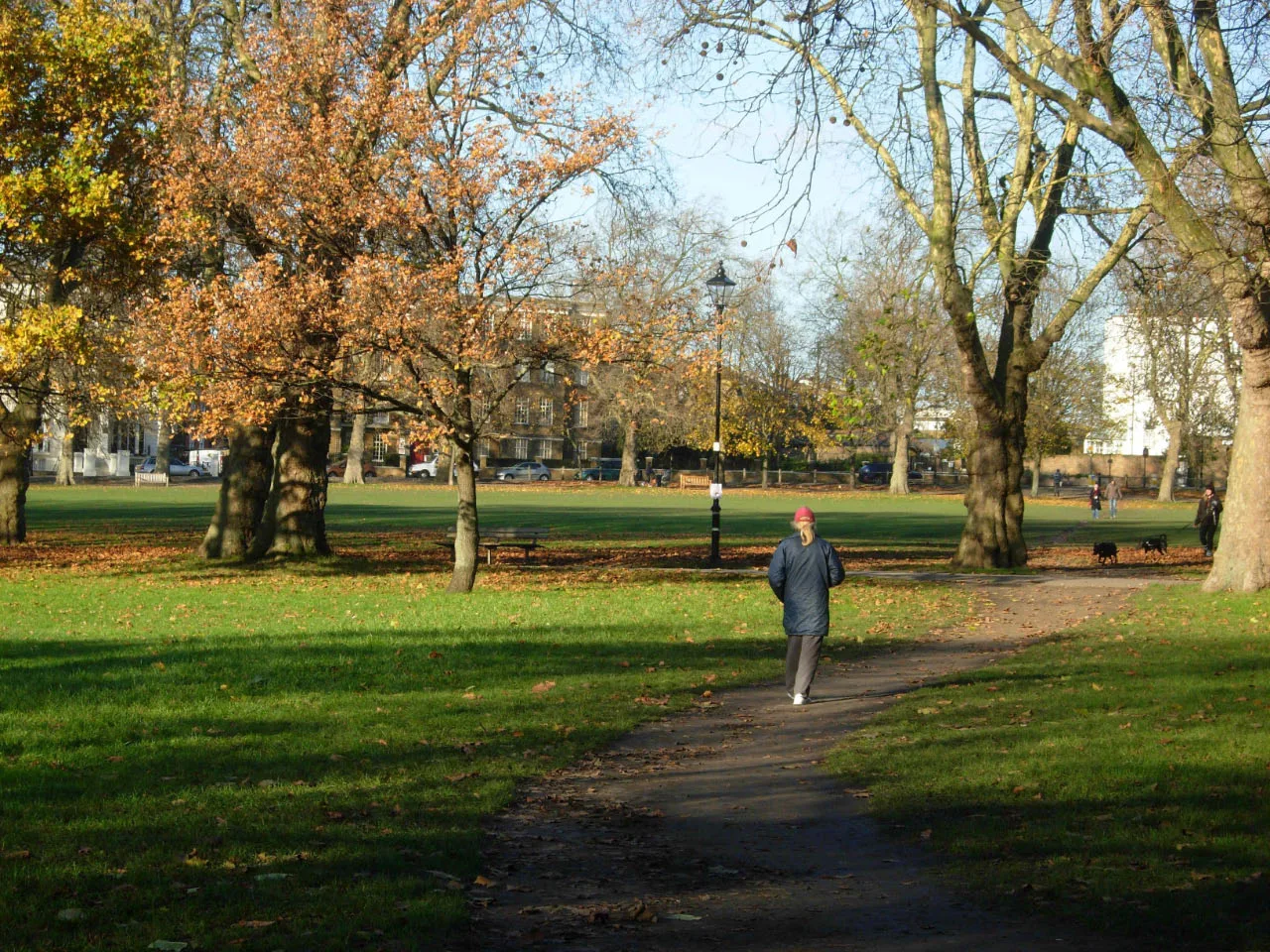

Walk a dog in Islington without a bag and you commit an offence, even if it never fouls. Agreed 22 October, with a £300 fine planned once a new law starts.
Anyone walking a dog in Islington will have to carry a bag or scoop to clear up after it. Not having one will be an offence in itself, whether or not the dog fouls.
Islington Council’s Executive agreed the new rule on Thursday 22 October, according to the printed decisions. It is part of a three-year renewal of the borough’s dog control order, which was due to run out on 31 October.
The Executive also renewed the order that lets officers stop people drinking in public where it causes nuisance. Both orders now run until 31 October 2029.
What the new dog rules say
The renewed order keeps the two rules Islington already had and adds two more. The full wording is in the report to the Executive.
It is an offence, on land the order covers, to:
- fail to put a dog on a lead when an authorised officer tells you to
- take a dog into, or let it stay in, one of the dog-free areas listed in the order
- fail to pick up after your dog straight away (new)
- fail to show an officer a bag or other means of picking up dog mess when asked (new)
The fouling rule closes two common excuses. Not noticing that the dog had fouled does not count as a reasonable excuse, and neither does having nothing to pick it up with. Putting the mess in a dog bin or litter bin on the land counts as removing it.
The bag rule applies “whether or not the dog has defecated”, the order’s wording says. A dog fouling bag counts, as does any other device that lets you carry the mess to a bin.
The fines
Breaking the order can lead to a fixed penalty notice, or a fine of up to £1,000 if the case goes to court.
The council wants to set the fixed penalty at £300, cut to £150 if paid within 14 days. That would match what it charges for littering, the report says.
It cannot do that yet. The legal maximum for this kind of fixed penalty is currently £100. The Crime and Policing Act 2026 raises it to £500, but the report says that section is not in force and has no start date. The Executive approved the £300 tariff “in principle”, subject to that law starting and to final legal advice.
Where dogs are banned
The list of dog-free areas is unchanged. It runs ward by ward across the borough and covers:
- fenced children’s playgrounds, in parks and on council estates
- marked sports areas such as football pitches and ball courts
- some small gardens and squares in full, such as Lonsdale Square and St Silas Church Gardens in Barnsbury
On Highbury Fields, for example, the order covers the playground, the wildlife garden, the sports facilities, the enclosed play areas opposite the café and two fenced areas below the football pitch. Registered assistance dogs are exempt.
What residents said
The council consulted from 20 July to 6 September and received 232 responses. Support for each measure among those who answered:
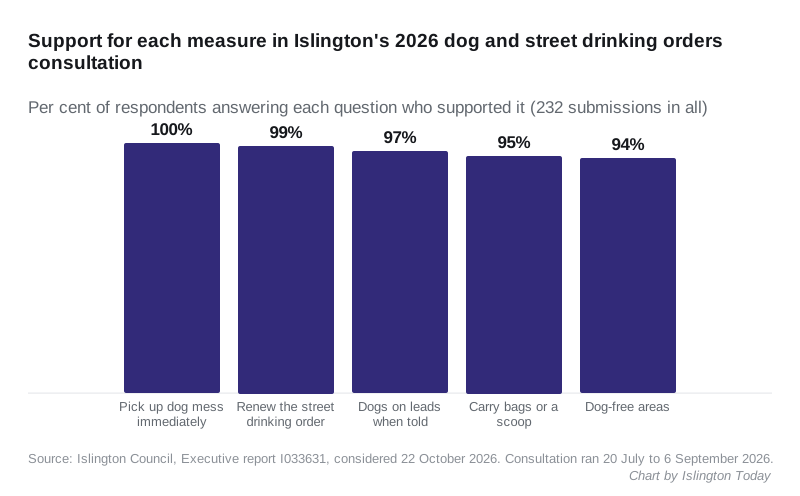
- picking up dog mess immediately: 100%
- renewing the street drinking order: 99%
- dogs on leads when directed: 97%
- carrying a bag or scoop: 95%
- dog-free areas: 94%
The report says the council chose the stricter option because of “a clear increase in dog fouling reports”. It does not give the number of reports.
The street drinking order
The renewed alcohol order does not ban drinking in public. It lets a police officer, a PCSO or an authorised council officer tell someone to stop drinking, or to hand over alcohol, where they believe that is needed to prevent nuisance or disorder. Refusing without a reasonable excuse is the offence.
The report says the powers are still needed for persistent street drinking, transport hubs, town centres, events and Arsenal match days.
What it means for you
If you walk a dog, carry a bag every time you go out, including on short walks. An officer can ask to see one even if your dog has not fouled.
If you rely on a dog because of a disability, the order keeps the assistance dog exemption for the dog-free areas. The council’s equality assessment also says the fouling rule keeps a “reasonable excuse” defence, and that officers will be trained to take disability into account.
If you want to challenge the order, anyone who lives, works or regularly visits the area can apply to the High Court within six weeks of an order being varied, the report says.
Councillors can call the decision in for review until 27 October. If nobody does, it takes effect on 28 October, according to the decision record. The council must then publish the orders on its website and put up signs where they apply.
For your bin day and what goes in which bin, see our Islington bin collection days page.
Sources
- Executive report: Public Spaces Protection Orders, Extension, Variation and Enforcement Framework 2026, I033631, Islington Council, including the order wording, Schedule 1 and the Equalities Impact Assessment
- Printed decisions of the Executive, 22 October 2026, Islington Council
- Decision record: Extension of PSPOs for dog control and alcohol-related ASB, Islington Council
Have your say