
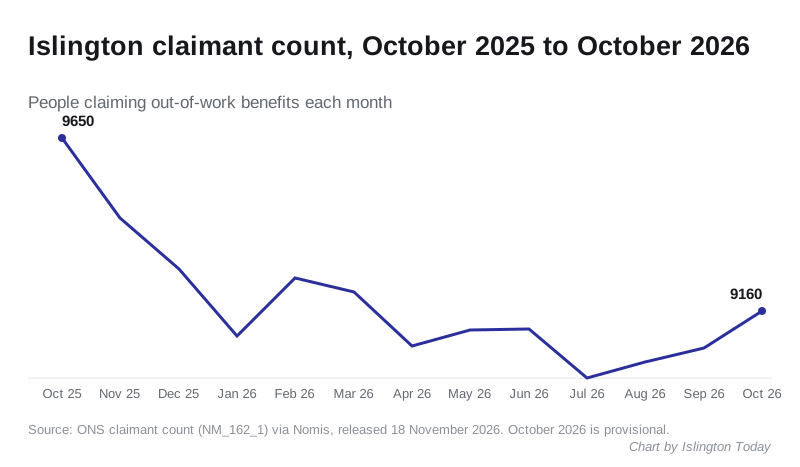
9,160 Islington residents claimed out-of-work benefits in October, up 105 in a month but 490 fewer than a year ago. September was revised down to 9,055.
9,160 Islington residents were claiming out-of-work benefits in October 2026. That is 105 more than in September. It is still 490 fewer than in October 2025, a fall of 5.1% in a year.
The October figure is provisional. The Office for National Statistics published it on 18 November through Nomis. The count covers people on Jobseeker’s Allowance and Universal Credit claimants who are required to look for work.
Overview
- 9,160 claimants in October 2026, 5.4% of Islington residents aged 16 to 64.
- Up 105 on September, a rise of 1.2%.
- Down 490 on October 2025, when the count was 9,650.
- September revised down from 9,265 to 9,055, so September’s rise was 40, not 250.
- Highest ward rate: Finsbury Park, 6.9% in September. Lowest: Highbury, 3.8%.
September was smaller than first reported
When we reported September’s figures on 26 October, the first estimate was 9,265, a rise of 250 in a month. The ONS now puts September at 9,055. That makes the September rise 40, not 250.
The revised figures show a slow climb rather than a jump:
- July: 8,970, the lowest since January 2024.
- August: 9,015.
- September: 9,055.
- October: 9,160.
October’s 105 is the biggest monthly rise since February 2026, when the count went up by 165.
Rising slower than London
The count rose across London in October, by 7,465 to 351,020. That is a rise of 2.2%, almost twice Islington’s 1.2%. Across the UK it rose 2.1%, to 1,707,320.
Over the year the picture is clearer. Islington’s count is 5.1% lower than in October 2025. London’s is 0.6% higher. Of the borough’s three neighbours, only Haringey and Camden are also lower than a year ago, and neither by as much.
| Area | Oct 2026 | Change on Oct 2025 | Share of 16 to 64s |
|---|---|---|---|
| Haringey | 13,845 | down 215 | 7.4% |
| Hackney | 13,700 | up 40 | 7.0% |
| Camden | 7,345 | down 85 | 4.6% |
| Islington | 9,160 | down 490 | 5.4% |
| London | 351,020 | up 2,105 | 5.6% |
Figures from the ONS claimant count for each area, via Nomis.
Young claimants
1,435 claimants were aged 16 to 24 in October. That is 30 more than in September and 10 more than a year ago (Nomis, by age). The 16 to 24 count has risen by 90 since August, when it was 1,350, while the overall count has moved far less.
Which wards have the most claimants
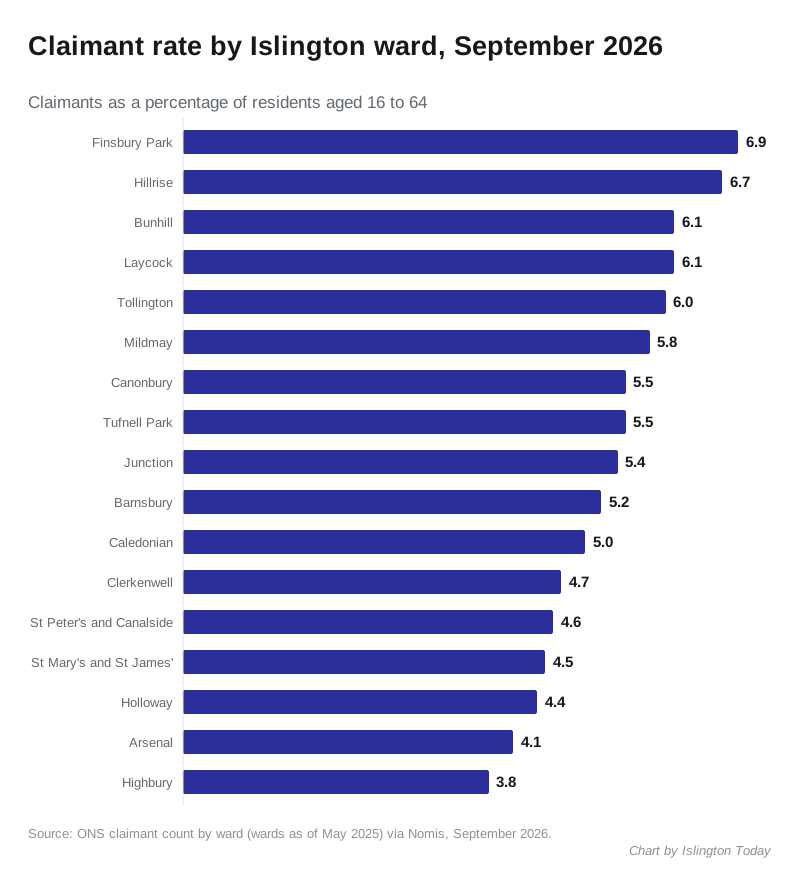
The ONS publishes ward figures a month behind the borough total, so the latest are for September (Nomis, by ward).
- Finsbury Park has both the most claimants, 810, and the highest rate, 6.9%. It has overtaken Hillrise on rate since August.
- Hillrise follows at 6.7%, with 710 claimants.
- Bunhill and Laycock are next, both at 6.1%.
- Highbury has the lowest rate, 3.8%, with 380 claimants.
What it means for you
The claimant count is not the same as unemployment. Some claimants are in low-paid work and are still required to look for more. Some people out of work claim nothing. It is the only measure published every month down to ward level, which is why it is worth watching.
If you are looking for work or training, the council runs youth employment hubs, supported internships and the Connect to Work programme for residents with disabilities or long-term health conditions. It says it aims to help 1,000 residents into work and 1,000 into apprenticeships, backed by £3.6 million of government and regional funding (Islington Council). Its contact centre is on 020 7527 2000.
The November figures are due in December.
Sources
- ONS claimant count (NM_162_1) for Islington, neighbouring boroughs, London and the UK, via Nomis, read 18 November 2026.
- Ward figures, wards as of May 2025, September 2026, via Nomis.
- Islington Council, 27 July 2026, on its employment programmes.
Have your say