
Queen Square doctors join two ARIA-funded teams testing deep brain stimulation through veins and a vine-like soft robot. Both are at an early preclinical stage.
Doctors at the National Hospital for Neurology and Neurosurgery (NHNN) are working on two of the 10 research teams funded by the Advanced Research and Invention Agency’s £50 million programme to reach the brain without opening the skull. One team wants to deliver deep brain stimulation through the veins; the other is building a soft robot that grows like a vine. University College London Hospitals NHS Foundation Trust (UCLH), which runs the hospital, announced its part on 12 November.
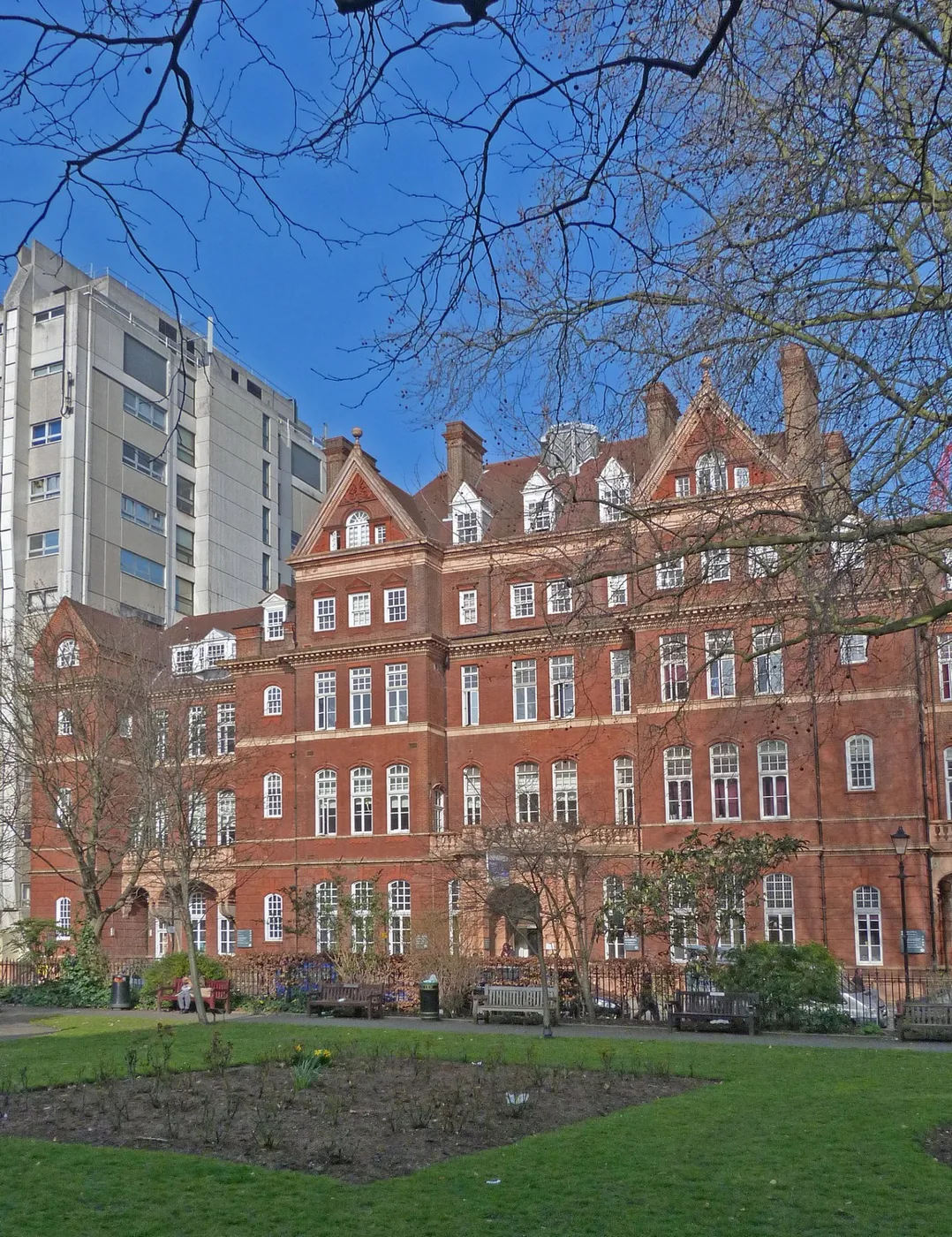
NHNN is in Queen Square, Bloomsbury, a short walk over the Camden border, and UCLH describes it as the UK’s largest dedicated neurological and neurosurgical hospital.
Overview
- The money: ARIA’s Massively Scalable Neurotechnologies programme is worth £50 million and backs 10 teams.
- The aim: less invasive ways to “reach, read and modulate brain circuits without the need for conventional brain surgery”, UCLH said, for conditions such as Parkinson’s disease.
- NHNN’s part: clinicians on two projects, one led by NeuroBionics and one called VINES.
- The stage: both studies are preclinical. Neither is treating patients.
Stimulation delivered through the veins
Deep brain stimulation today means open brain surgery. The NeuroBionics-led project, called Unlocking Minimally Invasive Deep Brain Stimulation with Endovascular Neuromodulation Technology, is testing whether microscopic electrical fibres can instead be threaded through veins inside the brain to reach deep brain structures.
The flexible fibres would go in by catheter, using techniques “similar to those already used in interventional neuroradiology”, UCLH said. If it works, the trust said, the technology “could provide a safer and less invasive alternative to conventional deep brain stimulation for people living with conditions such as Parkinson’s disease.”
The partners are Boston-based NeuroBionics, NHNN, Oxford University and the Royal Veterinary College. Dr Shah Islam, a consultant interventional neuroradiologist at NHNN, brings expertise in functional endovascular surgery and neuro-navigation and will help judge the clinical potential of the technique in new brain targets.
“We have just started to scratch the surface of what is possible in terms of endovascular neuromodulation and how we can take advantage of existing endovascular infrastructure to deliver these novel treatments at scale,” Dr Islam said.
A soft robot that grows like a vine
Three NHNN neurosurgeons, William Muirhead, Hani Marcus and Harith Akram, are on VINES (Vine Robots for Intracranial Navigation and Endocisternal Stimulation). It brings together the University of Leeds, UCL, King’s College London, the University of Cambridge, the Royal Veterinary College and the University of Florida.
The team is asking whether the fluid-filled spaces around the brain and spinal cord could be a route for placing deep brain implants without drilling through the skull. Their device is a miniature soft robot that extends from its tip rather than being pushed along delicate tissue, and is steered by external magnets through the cerebrospinal fluid spaces. Once in place, it would leave a tiny implant in a chosen area of the brain, powered wirelessly with no implanted battery.
“Cerebrospinal fluid corridors are well known to neurosurgeons as routes to deep brain structures,” William Muirhead said. “This ARIA award gives us a unique opportunity to understand whether they can facilitate minimally invasive robotic brain surgery.”
The NHNN team supplies the neurosurgical expertise, alongside specialists in robotics, medical imaging and bioengineering. The study is a 36-month preclinical feasibility study, testing whether implant-based brain therapies could become less invasive and more accessible to patients.
What it means for you
- Nothing changes at the hospital yet. Both projects are at an early preclinical stage, UCLH said, so there is no trial to join and no new treatment on offer.
- The timescale is years. The VINES study alone runs for 36 months before anyone knows whether the approach is feasible.
- Who it is for, if it works: people with neurological conditions such as Parkinson’s disease, for whom a treatment that avoids opening the skull would be “safer and less invasive”, in the trust’s words.
UCLH said the studies “have the potential to open entirely new avenues for treating disorders of the brain and nervous system.”
Have your say