
Band D is £2,107.87 in 2026/27, up 4.77%. The full A to H table, the £20 error in the council's own band A row, and the 29 homes billed £525.72 extra.
A band D home in Islington pays £2,107.87 in 2026/27, an increase of £96.05 or 4.77% on last year. Twenty-nine homes around one private garden in Clerkenwell pay £525.72 more than that before any discount.
The full A to H table is below, along with the three precepts inside the bill and what each of them did this year. Two figures in the council’s own published breakdown do not add up, and both are set out here with the arithmetic.
Everything was read from Islington Council’s council tax pages and its January 2026 taxbase report on 1 September 2026.
The 2026/27 charges, band A to H
| Band | Total for the year | Monthly over 12 |
|---|---|---|
| A | £1,405.25 | £117.10 |
| B | £1,639.45 | £136.62 |
| C | £1,873.67 | £156.08 |
| D | £2,107.87 | £175.65 |
| E | £2,576.29 | £214.70 |
| F | £3,044.70 | £253.72 |
| G | £3,513.12 | £292.76 |
| H | £4,215.74 | £351.31 |
Source: the council’s how we work out your bill page. The monthly column is a guide for direct debit only. A standard bill is spread over 10 months unless you pay by direct debit, in which case it is spread over 12.
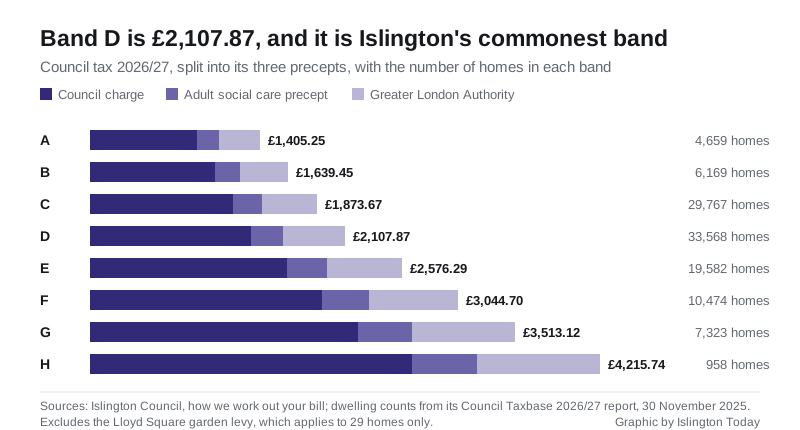
Band D is not a notional middle in Islington, it is the commonest band. The council’s taxbase report for 2026/27 counted 112,500 dwellings in the borough on 30 November 2025: 4,659 in band A, 6,169 in B, 29,767 in C, 33,568 in D, 19,582 in E, 10,474 in F, 7,323 in G and 958 in H. Bands C and D together are 56% of every home in Islington.
What makes up the bill
Three charges are added together. The council’s own charge, the adult social care precept it is allowed to levy on top, and the Greater London Authority precept that funds the Metropolitan Police, the fire brigade and Transport for London.
| Band | Council’s charge | Adult social care precept | GLA precept |
|---|---|---|---|
| A | £886.05 | £178.86 | £340.34 |
| B | £1,033.72 | £208.67 | £397.06 |
| C | £1,181.40 | £238.48 | £453.79 |
| D | £1,329.07 | £268.29 | £510.51 |
| E | £1,624.42 | £327.91 | £623.96 |
| F | £1,919.77 | £387.53 | £737.40 |
| G | £2,215.12 | £447.15 | £850.85 |
| H | £2,658.14 | £536.58 | £1,021.02 |
One number there is ours, not the council’s. Islington’s published table gives the band A council charge as £866.05. Every other row on the page is exactly the band D figure multiplied by that band’s statutory ratio, and band A’s ratio is six ninths: £1,329.07 x 6/9 is £886.05. Using the council’s own £866.05, band A’s three parts add up to £1,385.25, which is £20 short of the £1,405.25 total it prints two tables higher. The total is right, the component is a typo, and band A householders reading the breakdown are looking at a £20 error.
It is not a new one. The archived version of the same page for 2025/26 had the same problem in the same row, that time in the adult social care column: it printed £168.57 where the arithmetic gives £158.57.
What changed this year
| 2025/26 | 2026/27 | Change | |
|---|---|---|---|
| Council charge and social care precept | £1,521.44 | £1,597.36 | +£75.92, +4.99% |
| GLA precept | £490.38 | £510.51 | +£20.13, +4.10% |
| Band D total | £2,011.82 | £2,107.87 | +£96.05, +4.77% |
Islington took its share to the legal maximum. A council with social care responsibilities can raise council tax by 2.99% plus a further 2% for adult social care without a referendum, and 4.99% is exactly what it did. Split out, the core charge rose £45.49 and the social care precept rose £30.43, which is 2.99% and 2.00% of last year’s combined band D.
The 2025/26 figures come from the archived version of the council’s page, captured in May 2025.
A second error, in the funding table
The same page carries a table of what the council needs to raise. It gives £132.308m for the council budget at £1,597.36 a band D property, £42.285m for the GLA at £490.38 a band D property, and a total of £2,107.87.
£1,597.36 plus £490.38 is £2,087.74, not £2,107.87. The GLA row is carrying last year’s precept. Divide the GLA’s £42.285m by the taxbase of 82,829.19 band D equivalents that the council approved in its own taxbase report and you get £510.51, which is the correct 2026/27 figure and the one the total is built on. The Mayor’s 2026/27 precept is £510.51 at band D across the 32 boroughs, up £20.13.
The taxbase itself grew slightly, from 82,672.17 band D equivalents to 82,829.19, a rise of 157.02 or 0.19%.
Lloyd Square: 29 homes with an extra bill
Islington collects a garden levy for Lloyd Square in Clerkenwell. It is set by the Lloyd Square Garden Management Committee under the Levying Bodies (General) Regulations 1992, and the council is legally required to collect it as part of council tax from the properties around the square. It is the borough’s only special expense.
| Band | Garden charge | Total bill |
|---|---|---|
| A | £350.48 | £1,755.73 |
| B | £408.89 | £2,048.34 |
| C | £467.31 | £2,340.98 |
| D | £525.72 | £2,633.59 |
| E | £642.55 | £3,218.84 |
| F | £759.37 | £3,804.07 |
| G | £876.20 | £4,389.32 |
| H | £1,051.44 | £5,267.18 |
There are 29 dwellings in the levy area, 28 of them chargeable, and they are almost all at the top of the scale: 18 are band G and five are band H, according to Appendix B of the taxbase report. A band G house on the square pays £4,389.32 a year.
One oddity: the garden charge is the only part of an Islington bill that went down this year. At band D it fell from £530.58 to £525.72, a cut of £4.86.
Checking and challenging your band
Bands are set on what a property was worth in April 1991, not on what it is worth now.
- Look up your band on the Valuation Office Agency’s checker.
- To challenge it, use the VOA’s own process on GOV.UK. Islington cannot change your band; only the VOA can.
- If you have just become liable for the first time, or the property has just been banded, you have six months from your first bill to appeal the valuation.
- Keep paying while an appeal is running. The council is explicit about that.
Discounts and exemptions
- Single person discount, 25% off. For anyone who is the only adult aged 18 or over in the home.
- Older person’s discount, up to £100 off. Islington runs this one itself. You must be of state pension age, aged 65 or over, and living in the property as your main home. If your bill is under £100 the discount wipes it out entirely.
- Student exemption, where everyone in the household is in full-time education.
- Discounts also exist for carers, care leavers, apprentices, foster carers, people with a severe mental impairment and disability-related adaptations. All are on the council’s get money off your bill page, and all have to be applied for.
Council Tax Support
Islington’s scheme is one of the more generous in London, and nobody on it pays nothing by default. From the Council Tax Support page:
- You pay no council tax at all if you are not working and you receive any rate of Personal Independence Payment or Disability Living Allowance, or Universal Credit with limited capability for work, or you are a single parent with no earnings and a child under five.
- If you are not working and none of those apply, you get 95% off.
- If you are working, support is banded by weekly take-home pay at 85%, 75%, 65%, 50% and 35%. The thresholds move with household size. A single person with no children gets 85% up to £26.40 a week; a couple with two children gets 85% up to £153.07 a week.
- Support stops entirely above the top income band.
- Living with another adult who is not your partner cuts your support by £7.92 a week per person, unless they are on Income Support, income-based JSA, income-related ESA, Pension Credit or Universal Credit with no earnings.
Savings and investments above £16,000 rule you out. Islington ignores war widow and war widower pensions when it calculates pension-age support.
The scheme is not small. The taxbase report deducts 18,994 band D equivalents from the borough’s taxbase for the cost of Council Tax Support, out of 95,731 adjusted dwellings.
Empty homes and second homes
Islington charges some of the steepest premiums in the country, set out on its empty and second homes page:
| Situation | You pay |
|---|---|
| Empty and unfurnished, first year | Standard rate |
| Empty and unfurnished, over one year | 200% |
| Empty and unfurnished, five to ten years | 300% |
| Empty and unfurnished, over ten years | 400% |
| Second home, furnished, from 1 April 2025 | 200% |
At band D that is £4,215.74 after a year, £6,323.61 after five and £8,431.48 after ten.
Some properties are held at the standard rate for a year regardless: those inherited and awaiting sale or transfer after probate, those genuinely on the market for sale or let, and those undergoing major repairs or structural work. Annexes in use as part of the main home, homes you must occupy under an employment contract, and seasonal homes you are not permitted to live in year-round are exempt from the second home premium.
The premiums bite on real numbers. The taxbase report counts 253 second homes in the borough and 388 dwellings paying an empty home premium: 259 at double, 102 at triple and 27 at quadruple.
Where the money goes
The council needs £132.308m from council tax for its own budget in 2026/27 and collects a further £42.285m for the GLA, a total of £174.593m. Its spending breakdown puts the largest single call on council tax at Health and Social Care, £128.489m after income, followed by Children and Young People at £82.385m.
Also on Islington Today
- Islington bin collection days, the service most of this pays for
- Parking in Islington, permit prices and the zone hours
- Islington house prices, what homes in each band are worth now
Have your say